

The moment you realize your child might be using again can feel like the ground shifting beneath you.
Maybe you noticed subtle changes first. A shift in their mood. Missed calls. A sense that something isn’t quite right.
Then the truth starts to emerge.
For many parents, that realization brings a wave of emotions—fear, guilt, frustration, and an overwhelming question:
What kind of help will actually work this time?
Some families find that exploring structured daytime care offers a path forward—one that provides meaningful support without requiring full residential care.
If your 20-year-old has relapsed, you’re not alone. And despite how heavy things feel right now, recovery is still very possible.
The Emotional Whiplash Parents Often Experience
Parents of young adults often describe relapse as emotional whiplash.
Just when things started to feel stable—when hope began to return—everything suddenly feels uncertain again.
You may find yourself thinking:
- Did we move too fast?
- Did we miss the warning signs?
- Did we do something wrong?
These questions are incredibly common.
When someone you love is struggling, it’s natural to search for explanations. Parents often carry a quiet sense of responsibility for their child’s well-being long after that child becomes an adult.
But substance use struggles rarely have a single cause.
They’re influenced by emotional stress, mental health challenges, peer environments, and brain development—especially during young adulthood.
What you’re seeing now is not a personal failure.
It’s a signal that your child needs renewed support.
Why Age 20 Is Such a Vulnerable Time
Twenty years old is a complicated age.
Young adults are navigating independence for the first time while still developing emotionally and neurologically.
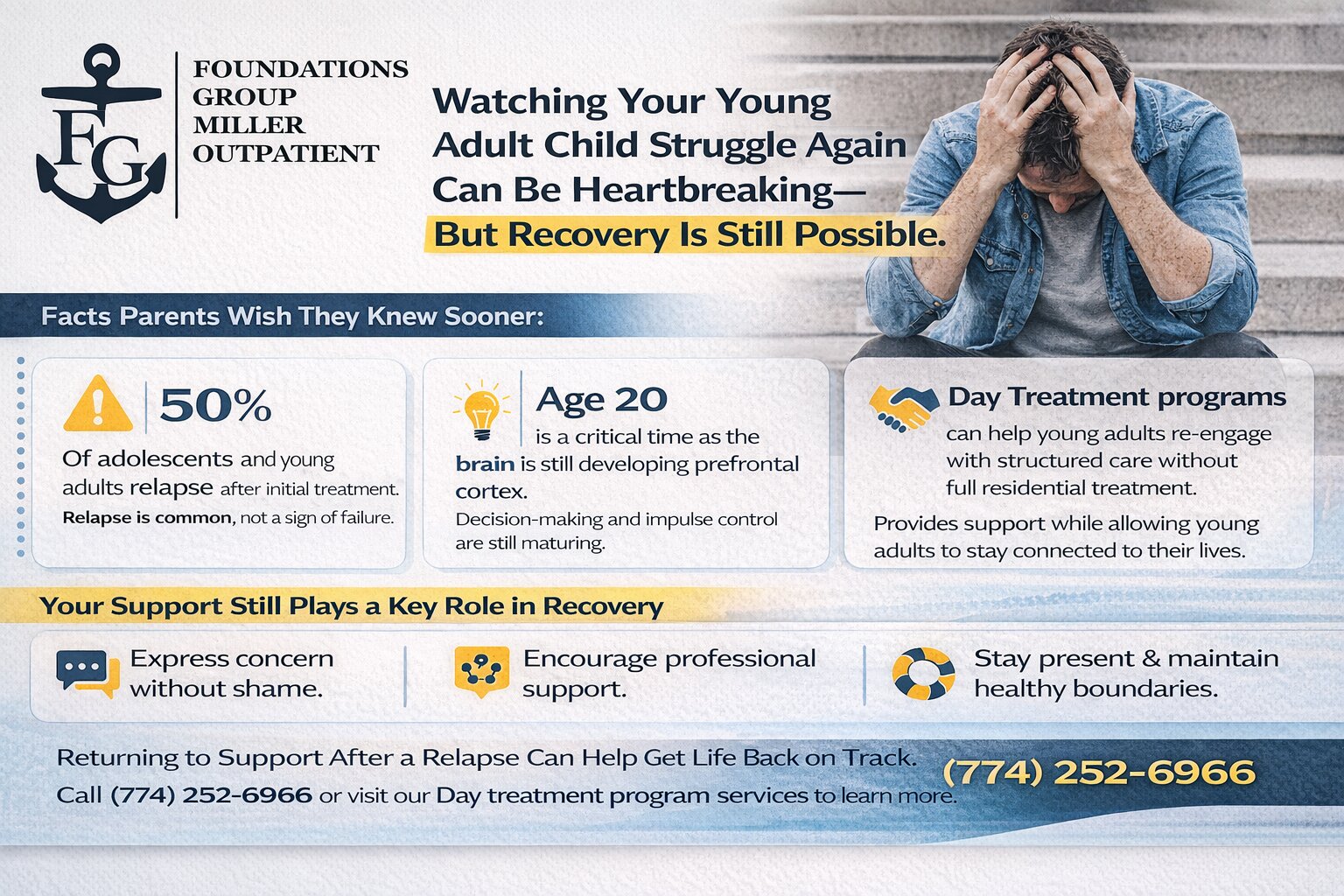
The brain’s decision-making center—the prefrontal cortex—is still developing well into the mid-twenties. This affects impulse control, risk assessment, and emotional regulation.
At the same time, young adults are facing intense pressure:
- figuring out career or education paths
- navigating relationships and identity
- managing new levels of freedom and responsibility
Substances can easily become a coping mechanism during this stage.
When a relapse happens, it doesn’t mean your child lacks strength or motivation.
It often means the challenges they’re facing have outpaced the support systems around them.
Why Some Young Adults Resist Residential Treatment
Parents often assume that returning to residential treatment is the only solution after relapse.
But young adults frequently resist that idea.
For many 20-year-olds, residential care can feel like losing independence just as they’re trying to build it.
They may worry about:
- stepping away from school or work
- losing connection with friends
- feeling like they’re being controlled again
- starting over socially
These concerns don’t necessarily mean they don’t want help.
They may simply be searching for a type of support that feels less overwhelming and more integrated with their lives.
That’s where structured daytime support can sometimes bridge the gap.
How Structure Helps Rebuild Stability
One of the most powerful elements of recovery for young adults is structure.
Substance use often disrupts daily rhythms—sleep patterns, responsibilities, and routines.
Days blur together. Motivation fades. Emotional regulation becomes harder.
Structured daytime support helps reintroduce rhythm into a young person’s life.
Therapy sessions, skill-building activities, and peer support create a consistent environment where recovery can start gaining momentum again.
Think of structure like scaffolding around a building under repair.
It doesn’t replace the building—it supports it while healing happens.
What Parents Often Notice First When Progress Begins
When young adults re-engage with meaningful support, the first changes are often subtle.
Parents might notice things like:
- more consistent sleep schedules
- improved communication at home
- a willingness to talk about difficult emotions
- greater openness to accountability
These changes can feel small at first.
Recovery rarely arrives with dramatic breakthroughs.
Instead, it tends to unfold through gradual shifts in awareness, habits, and confidence.
Over time, those small changes begin building real momentum.
Your Role as a Parent Still Matters
One of the most painful beliefs parents carry during relapse is the idea that they no longer have influence.
But even in young adulthood, parental support can make an enormous difference.
That support doesn’t mean controlling every decision.
It often means:
- expressing concern without shame
- maintaining clear and healthy boundaries
- encouraging professional support
- staying present through the ups and downs of recovery
Your child may not always say it out loud.
But the stability you provide often becomes a quiet anchor during difficult periods.
Recovery for Young Adults Often Happens in Stages
Many parents hope that treatment will produce a permanent turning point.
While long-term recovery absolutely happens, the path toward it can be gradual.
Young adults may experience periods of progress, setbacks, learning, and growth along the way.
Each stage provides new insight and emotional development.
Relapse does not erase the work that has already been done.
In many cases, it becomes a moment where deeper understanding and stronger coping strategies begin to form.
One clinician described it this way:
“Recovery isn’t a straight staircase. Sometimes it’s a spiral—you revisit similar places, but each time with more awareness.”
When Families Begin to Feel Hope Again
Parents often ask the same question after relapse:
How will we know if things are getting better?
Hope usually returns gradually.
It may start with a conversation that feels more honest than previous ones. A willingness to show up for therapy. A small but meaningful shift in responsibility.
Recovery tends to rebuild trust slowly—one step at a time.
Structured support environments help create the consistency needed for those steps to happen.
And while the journey may feel uncertain right now, many families eventually look back and realize that relapse was not the end of the story.
It was simply another chapter in recovery.
FAQ: Questions Parents Often Ask After Their Child Relapses
Is relapse common for young adults?
Yes. Young adults are still developing emotionally and neurologically, which can make recovery more complex during this stage of life. Many people experience setbacks before achieving long-term recovery.
Does relapse mean treatment failed?
Not at all. Recovery often involves learning experiences that unfold over time. Previous treatment may still provide important tools and insights that support future progress.
How can I help my child without pushing them away?
Balancing support and boundaries can be challenging. Open communication, expressing concern without judgment, and encouraging professional help are often the most effective approaches.
What if my child refuses help?
Resistance is common, especially in young adulthood. Continuing to communicate care and concern while seeking guidance from professionals can help families navigate this situation.
Is there support available for parents too?
Yes. Many treatment programs offer resources, education, and counseling that help families understand addiction and support their loved one more effectively.
How do we know what level of care is appropriate?
A professional assessment can help determine what type of support might be most helpful based on your child’s needs, history, and current situation.
Watching your child struggle again can feel heartbreaking.
But relapse does not erase the possibility of recovery.
Call (774) 252-6966 or visit our Day treatment program services to learn more about our Day treatment program services in Cape Cod, MA.