

I didn’t expect to need that level of support again.
I had time under my belt. Real time. The kind people congratulate you for. The kind that makes you the “example” in meetings.
And yet, somewhere along the way, things started to feel quiet in a way that wasn’t peaceful.
If you’ve ever caught yourself wondering whether returning to a day treatment program makes sense after years away, I want to talk to you like someone who’s been there.
Not from a crisis.
From a slow drift.
The Subtle Drift No One Talks About
Relapse is loud.
Disconnection is quiet.
I didn’t wake up one day in chaos. I woke up tired. Emotionally flat. Going through the motions. Still sober. Still functioning. Still checking all the boxes.
But the color had drained out of things.
At first, I blamed stress. Work. Relationships. Life being life.
But there was a deeper truth underneath it: I had slowly detached from the kind of structured support that once kept me grounded.
Not dramatically. Gradually.
And that gradual drift can be harder to admit than a crisis.
“I Shouldn’t Need This Anymore”
This is the sentence that almost kept me from going back.
“I should be past this.”
There’s an unspoken pressure among long-term alumni to level up and stay leveled up. To prove that treatment worked. To prove you’re stable now. Independent. Self-sufficient.
But recovery isn’t a one-time event. It’s maintenance. It’s recalibration. It’s staying connected to the work, even when you’re not in active danger.
Going back didn’t mean I failed the first time.
It meant I noticed something before it became bigger.
And that’s not weakness. That’s awareness.
When Sobriety Stops Feeling Alive
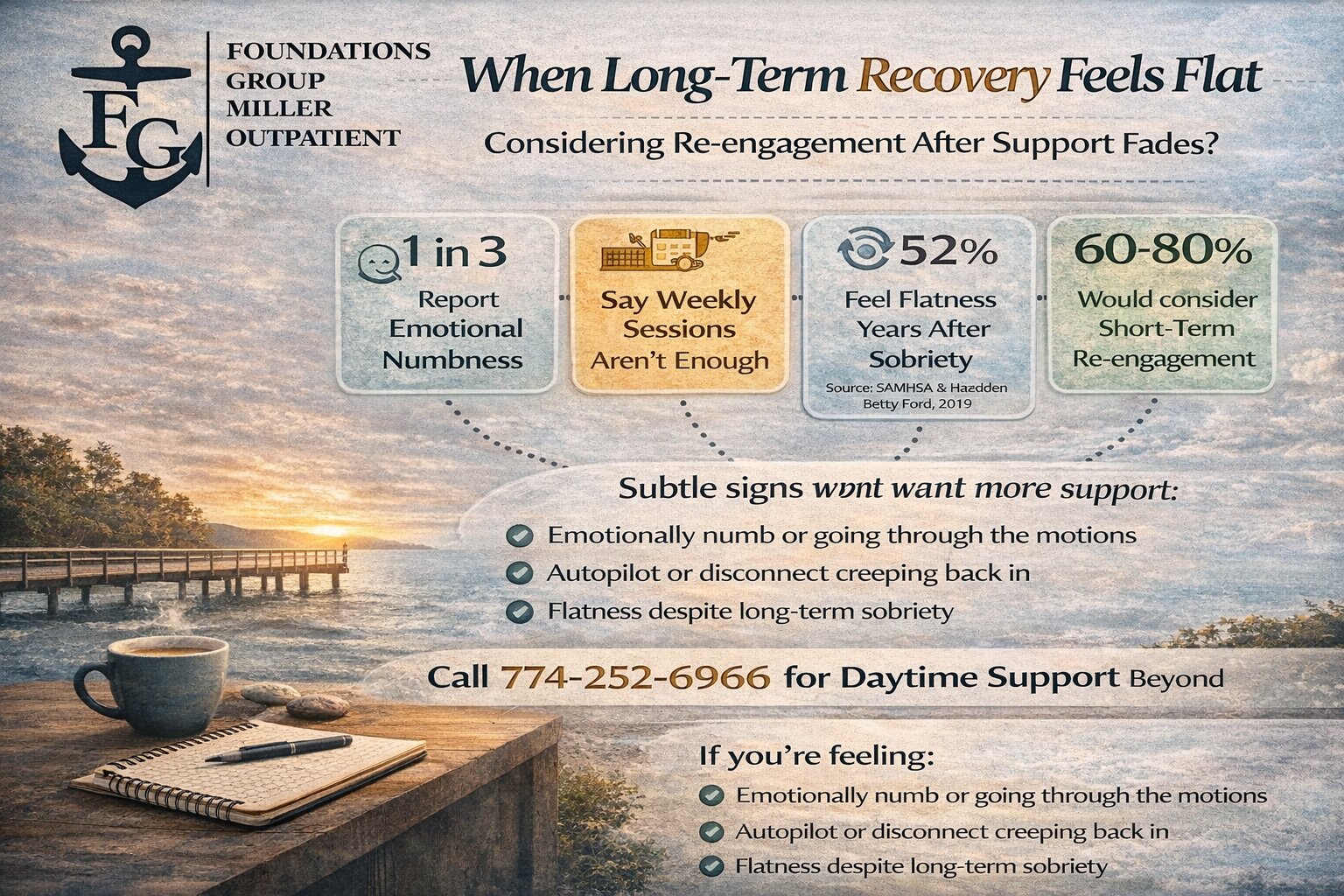
No one prepared me for emotional flatness years into recovery.
Early sobriety is intense. Everything is sharp. Feelings are loud. Growth feels visible.
But long-term recovery can sometimes turn into autopilot.
You’re not using. You’re not in chaos. But you’re also not fully present.
You laugh, but it doesn’t land.
You show up, but you don’t feel connected.
You go to meetings, but you don’t feel engaged.
You start asking yourself:
“Is this just adulthood?”
“Is this all there is?”
“Why do I feel empty when technically I’m okay?”
That’s when I realized I didn’t need to white-knuckle through it. I needed structure again.
Structure Isn’t Only for Crisis
I used to associate structured daytime care with emergencies.
People go there when they’re falling apart. When things are bad.
But here’s what I learned the second time around: structure can also be preventative.
It can be a place to:
- Reconnect emotionally
- Rebuild routine
- Get honest before things escalate
- Address mental health layers that surfaced later
- Strengthen coping skills for new life stressors
The second time felt different.
Less dramatic. More intentional.
I wasn’t scrambling for survival. I was choosing alignment.
And that shift matters.
Long-Term Alumni Have Different Needs
The work you do at 30 days is not the same work you need at three years.
Early recovery focuses on stabilization. Safety. Breaking patterns.
Later recovery often focuses on:
- Identity shifts
- Burnout
- Relationship fatigue
- Career pressure
- Grief that didn’t surface before
- Trauma layers that become clearer once substances are gone
Sometimes those deeper layers require more than a weekly therapy session.
Sometimes you need immersion again.
Not because you’re back at square one.
Because you’re evolving.
Pride vs. Honesty
Pride is loud.
It tells you that asking for more support means you’re slipping.
Honesty is quieter.
It says, “Something feels off. Let’s address it.”
I had to decide which voice I was going to listen to.
Going back into a day treatment program didn’t strip me of my sobriety. It strengthened it.
It gave me:
- Accountability
- Community
- Professional support
- A reset in perspective
- Space to feel again
Most importantly, it gave me momentum.
It’s Not Starting Over
This part matters.
Returning to structured care is not a reset button on your progress.
You’re not a beginner again.
You’re someone with lived experience walking back into support with more insight, more self-awareness, and more maturity than before.
The second time, I asked different questions.
I showed up differently.
I absorbed things differently.
What felt like repetition on paper felt like refinement in reality.
Signs You Might Benefit From Re-Engaging With Support
You don’t have to be in crisis to need more care.
Here are subtle signs I ignored for too long:
- You feel emotionally numb or disconnected
- You’re isolating more than usual
- Meetings or therapy feel surface-level
- Old thinking patterns are creeping in
- You’re functioning—but not fulfilled
- You’re exhausted in a way that sleep doesn’t fix
- You’ve stopped talking honestly about how you feel
None of these mean you’ve failed.
They mean something inside you wants attention.
The Courage of Coming Back
Walking back into a program when you’re not in crisis can feel humbling.
You might worry:
- “What will people think?”
- “Am I overreacting?”
- “Is this dramatic?”
But the real courage isn’t in pretending you’re fine.
It’s in responding early.
There is strength in choosing support before collapse.
There is wisdom in maintenance.
And there is dignity in saying, “I don’t want to drift any further.”
FAQ: Returning to Structured Support as a Long-Term Alum
Is it normal to feel stuck years into recovery?
Yes. Long-term sobriety doesn’t mean permanent emotional ease. Life evolves. Stressors change. Growth can plateau. Feeling stuck is often a signal that something needs attention—not a sign that recovery failed.
Does going back mean my first round of treatment didn’t work?
No. The first time likely gave you the foundation you’re standing on now. Returning is often about deepening the work, not replacing it.
Think of it like maintenance, not repair.
What if I’m not in crisis? Is it still appropriate?
Structured care isn’t only for emergencies. Many people return during periods of transition, burnout, or emotional stagnation. You don’t need to wait until things are falling apart.
Will I feel out of place as someone with long-term sobriety?
It’s common to worry about this. But many programs include alumni at different stages of recovery. Your experience can actually bring perspective to the group dynamic while still allowing you to receive support.
What if I’m embarrassed to reach out again?
Embarrassment is common—but it’s not a reason to stay stuck.
Programs are designed to support people at different points in their recovery. You’re not the first person to come back. And you won’t be judged for doing what’s healthy.
How do I know if this is what I need versus just a rough patch?
Ask yourself:
- Have I been feeling this way for more than a few weeks?
- Am I becoming more isolated?
- Am I minimizing how I feel?
- Would structured support give me accountability I’m currently missing?
If the answer is yes to several of those, it might be worth exploring your options.
You Don’t Have to White-Knuckle Long-Term Recovery
There’s a strange pressure in long-term sobriety to look stable at all times.
To have it figured out.
But recovery isn’t about performing wellness.
It’s about staying connected.
If something feels off—even quietly off—that matters.
You are allowed to return to structure.
You are allowed to need support again.
You are allowed to prioritize your stability before it slips.
That isn’t regression.
That’s growth with humility.
Call (774) 252-6966 or visit our Day treatment program services to learn more about our Day treatment program services in Falmouth, MA.