

Sometimes people don’t finish.
They stop showing up. They miss a few days. Then the gap gets wider. Then the phone feels heavier. Then the story in their head gets louder.
“If I go back, they’ll think I’m not serious.”
“I already messed it up.”
“They probably filled my spot.”
If you left treatment early — whether it was multi-day weekly treatment or another level of care — you are not unusual. You’re human.
And at Foundations Group Miller Outpatient in Falmouth, MA, we want you to hear something clearly:
The door is not locked behind you.
At our half-day outpatient treatment program, we regularly work with people who paused care, stepped away, or felt unsure if they could return. Re-engaging isn’t rare. It’s part of many people’s story.
Let’s talk about how it can work — gently, realistically, and without pressure.
1. First, Separate Shame From Facts
When someone leaves treatment mid-way, the mind fills in the blanks.
Fact: You stopped attending.
Story: “I failed.”
Fact: You relapsed.
Story: “I can’t do this.”
Fact: You felt overwhelmed.
Story: “I’m not cut out for recovery.”
The facts are workable. The shame story is what keeps people away.
Treatment is not a graduation ceremony you ruined. It’s support. And support can be restarted.
We’ve seen people return stronger, clearer, and more ready — not because they’re perfect, but because they learned something from stepping away.
Sometimes leaving teaches you what you actually need.
2. Understand Why You Left — Without Defending It
Before coming back, it helps to quietly ask yourself:
- Was the schedule too intense for my life?
- Did I feel emotionally flooded?
- Was I minimizing how much support I really needed?
- Did I start using again and feel embarrassed?
- Did fear creep in when things started to feel real?
You don’t need a polished explanation. You don’t need to justify anything to us.
But understanding your own “why” gives you clarity. And clarity reduces repeat patterns.
For many people who don’t complete intensive programming, the structure felt like too much too fast. That doesn’t mean treatment was wrong. It may mean the level of care didn’t match the season you were in.
That’s where a different pace can matter.
3. Consider a More Manageable Structure
If jumping back into multi-day weekly treatment feels intimidating, you’re not alone.
Half-day outpatient treatment offers structured daytime support while allowing you to return home each day. It can provide consistency without feeling like your entire week revolves around treatment.
This level of care can help if:
- You need accountability but not full-week intensity
- You’re rebuilding after a relapse
- You’re balancing work, school, or family
- You felt overwhelmed in a more intensive schedule
Sometimes recovery doesn’t need to be louder. It needs to be steadier.
For people in Falmouth and surrounding Cape Cod communities, having structured daytime care nearby often makes re-entry feel realistic. You don’t have to disappear from your life to get support — you can strengthen it while staying connected to it.
4. Make the First Contact Simple
You don’t need a big speech.
You don’t need to apologize.
You can say:
“I left a while ago. I’m thinking about coming back. What would that look like?”
That’s enough.
When someone reconnects with us, we’re not interested in interrogation. We’re interested in understanding what you need now.
The tone matters.
We don’t ask, “Why didn’t you stick with it?”
We ask, “How have you been since we last saw you?”
Because the goal isn’t to review your past attendance. It’s to support your present reality.
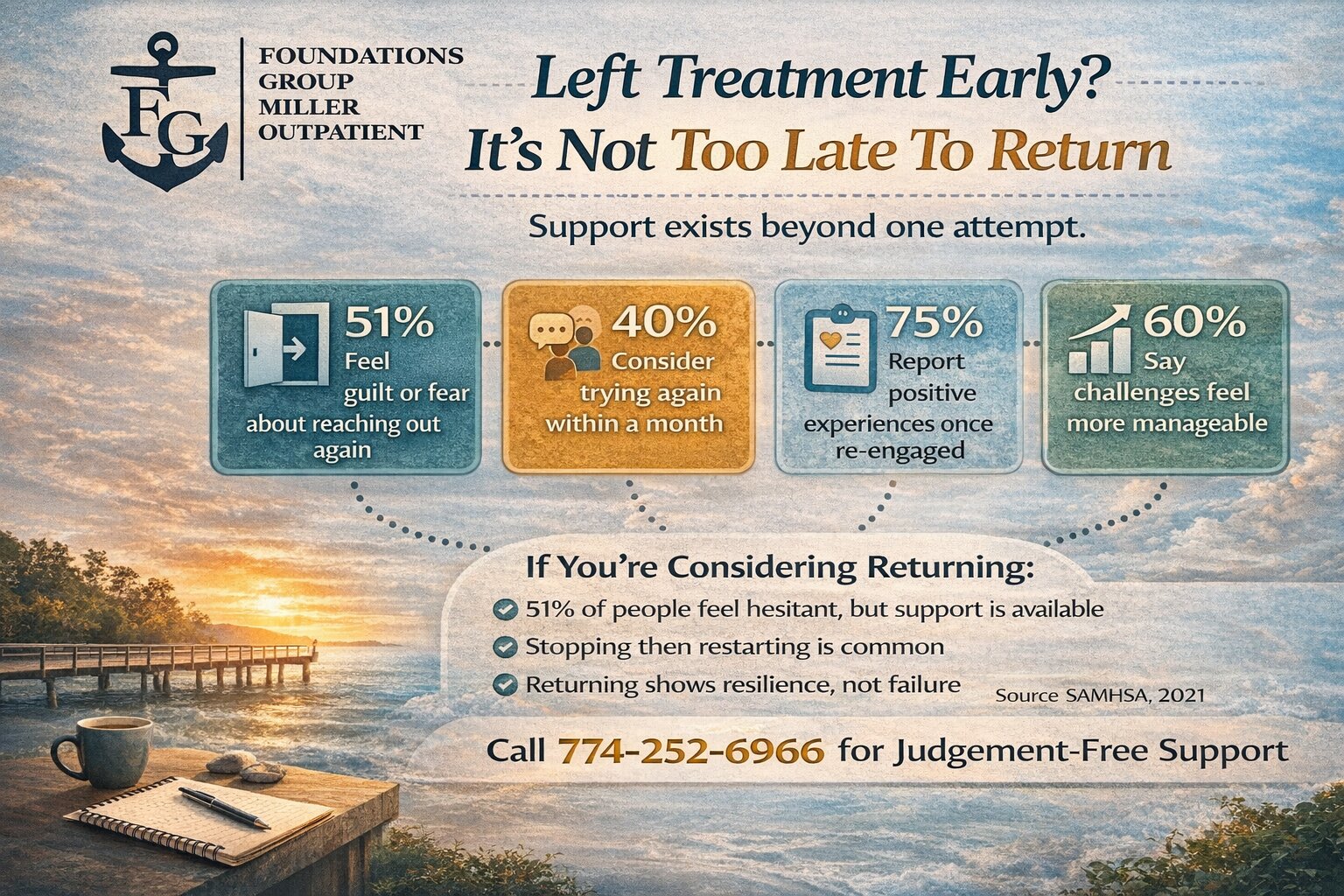
5. Expect Re-Entry to Feel Emotional
Coming back after leaving can stir up:
- Embarrassment
- Defensiveness
- Fear of being judged
- Anxiety about “starting over”
That’s normal.
What helps is remembering: treatment staff see this often. You are not the first person to step away. You won’t be the last.
Re-entry is not a walk of shame. It’s a decision to keep trying.
And that decision carries more strength than people realize.
6. Focus on Momentum, Not Perfection
When someone returns to care, they sometimes believe they need to “do it right” this time.
Perfect attendance.
Perfect participation.
Perfect honesty from day one.
Recovery doesn’t require perfection. It requires momentum.
Momentum looks like:
- Showing up even when it feels awkward
- Saying “I’m struggling” instead of disappearing
- Staying through discomfort instead of fleeing it
You don’t have to overhaul your entire life in one week.
You just have to take the next step.
7. Let the Program Adjust to You — Not the Other Way Around
One of the biggest fears people carry is:
“What if it doesn’t work again?”
That’s a valid concern.
But treatment isn’t a rigid mold you must fit into. It’s a collaborative process. When someone returns, we look at:
- What felt helpful before
- What didn’t feel sustainable
- What external stressors are present now
- What additional supports might be needed
Sometimes the change is structural.
Sometimes it’s therapeutic.
Sometimes it’s timing.
Care should evolve with you.
8. Remember That Pauses Don’t Erase Progress
Even if you relapsed.
Even if you ghosted.
Even if you avoided our calls.
The insight you gained didn’t vanish.
The coping tools you practiced are still somewhere in you.
The awareness you built is still there.
A pause in treatment doesn’t delete your growth. It interrupts it.
And interruptions can be repaired.
Frequently Asked Questions About Returning After Leaving Treatment
Will I have to start completely over?
Not necessarily. Re-entry is individualized. We assess where you are now — emotionally, medically, and behaviorally — and determine the appropriate next step. For some, it feels like picking up where they left off. For others, it means adjusting the level of care. The focus is forward, not backward.
What if I relapsed after leaving?
Relapse does not disqualify you from care. In fact, it often clarifies the level of support needed. Many people who return after a relapse feel more honest and ready to engage. You don’t need to hide it. We’d rather know the truth than have you carry it alone.
Will staff judge me for leaving?
No. We understand that treatment can feel overwhelming. Life happens. Fear happens. Avoidance happens. Our role is not to shame you. It’s to help you stabilize and move forward. If you’re worried about how it will feel walking back in, tell us that. Naming it reduces its power.
Is half-day care enough if I struggled before?
That depends on your specific needs. Half-day outpatient treatment can be an effective option for people who need structured support but benefit from a slightly less intensive rhythm.
During an assessment, we’ll talk honestly about whether this level of care matches where you are now. If a different level is more appropriate, we’ll discuss that too. The goal is alignment — not overdoing it or underdoing it.
What if I’m still unsure?
You don’t need 100% certainty to reach out. Ambivalence is common. You can call just to ask questions. You can schedule an evaluation without committing to anything long-term. Taking information-gathering steps is not the same as signing your life away. Clarity often comes after conversation, not before.
How quickly can I come back?
In many cases, re-engagement can happen quickly after assessment and scheduling. Availability can vary, but we work to minimize gaps whenever possible. The sooner you reach out, the sooner we can explore next steps together.
You’re Not the Only One Who Left
If you’re reading this quietly, wondering whether you’re “allowed” to try again, here’s the truth:
You are.
Leaving once doesn’t define you. Ghosting doesn’t ban you. Relapsing doesn’t disqualify you.
Recovery isn’t linear. It bends. It pauses. It restarts.
What matters most is that you’re considering coming back.
For people seeking structured, supportive care in Falmouth, MA, having a steady place to land can make all the difference. You don’t have to figure this out alone — and you don’t have to carry the weight of leaving.
You don’t need the perfect words to re-open the door.
Call (774) 252-6966 or visit our half-day outpatient treatment services in Falmouth, MA to learn more about what returning to care could look like for you.
We’re here. And we’ll meet you where you are.