

For a lot of people, getting help isn’t the scary part.
It’s figuring out how to make it work.
You may have reached a point where you’re questioning your relationship with alcohol, noticing your mental health slipping, or simply feeling exhausted by the effort it takes to keep everything together. You’re curious about change, but you’re also realistic. You have a job. Responsibilities. Bills. People depending on you.
Then the practical questions start showing up.
How much will this cost?
Will insurance cover any of it?
Can I still work?
Will I have to put my entire life on hold?
If you’ve spent hours searching for answers and ended up more confused than when you started, you’re not alone. Many people exploring day treatment options aren’t trying to avoid help. They’re trying to understand whether help can fit into their actual life.
The good news is that treatment isn’t always as disruptive, expensive, or impossible as people fear. The challenge is knowing how to evaluate your options without getting overwhelmed by insurance terminology, treatment jargon, and worst-case assumptions.
Step 1: Stop Assuming Treatment Is Automatically Out of Reach
One of the biggest barriers to treatment isn’t cost.
It’s what people assume the cost will be.
Many individuals rule out treatment before ever speaking with a provider. They convince themselves they won’t be able to afford it. They assume insurance won’t cover enough. They picture overwhelming medical bills and decide it’s easier not to find out.
Unfortunately, assumptions can become expensive.
We’ve seen people struggle for months or years because they were convinced treatment wasn’t financially possible, only to discover later that their insurance covered far more than they expected.
The reality is that every insurance plan is different.
Coverage depends on factors like:
- Whether the provider is in-network
- Your deductible status
- Copays or coinsurance
- Annual out-of-pocket maximums
- Medical necessity requirements
The key takeaway is simple: guessing isn’t a strategy.
The fastest way to understand your actual financial responsibility is to verify your benefits directly with a treatment provider.
Step 2: Understand Why In-Network Care Matters
Insurance terminology can feel intentionally confusing.
People hear phrases like deductible, authorization, coinsurance, and network status and immediately feel overwhelmed.
Let’s simplify it.
When a provider is in-network, they have a contractual agreement with your insurance company. That agreement often results in lower costs and better coverage than using an out-of-network provider.
While being in-network doesn’t eliminate all expenses, it can dramatically reduce them.
Think of it like having a membership discount that you’ve already been paying for through your insurance premiums.
Many people spend years paying for health insurance without fully understanding the benefits available to them.
One phone call can often provide more clarity than hours of internet research.
Step 3: Look Beyond the Price Tag
When people evaluate treatment, they usually focus on one question:
“What will this cost me?”
It’s understandable.
Money matters.
But it’s equally important to ask another question:
“What is my current situation costing me?”
For some people, the answer is obvious.
Maybe alcohol has started affecting relationships.
Maybe anxiety is making work harder than it should be.
Maybe depression is draining motivation, energy, and enjoyment from daily life.
For others, the costs are harder to measure.
Poor sleep.
Chronic stress.
Constant self-doubt.
The emotional weight of carrying everything alone.
Imagine trying to fill a bucket that has a slow leak.
Every day, you add more effort, more energy, and more determination.
But something keeps draining away.
At some point, fixing the leak becomes more important than continuing to refill the bucket.
Step 4: Be Honest About What “Working Fine” Really Means
Many people who search for treatment options are technically functioning.
They’re employed.
Paying bills.
Taking care of responsibilities.
Showing up.
From the outside, everything looks fine.
But functioning and thriving aren’t the same thing.
We’ve spoken with countless individuals who said things like:
“I’m doing okay.”
“I’m managing.”
“It’s not that bad.”
Then they describe panic attacks before work, drinking every night to unwind, constant anxiety, emotional exhaustion, or a growing sense that life feels smaller than it used to.
A surprising number of people aren’t asking whether treatment would help.
They’re asking whether they’re “bad enough” to deserve help.
That’s the wrong question.
The better question is:
“Would my life improve if I had more support?”
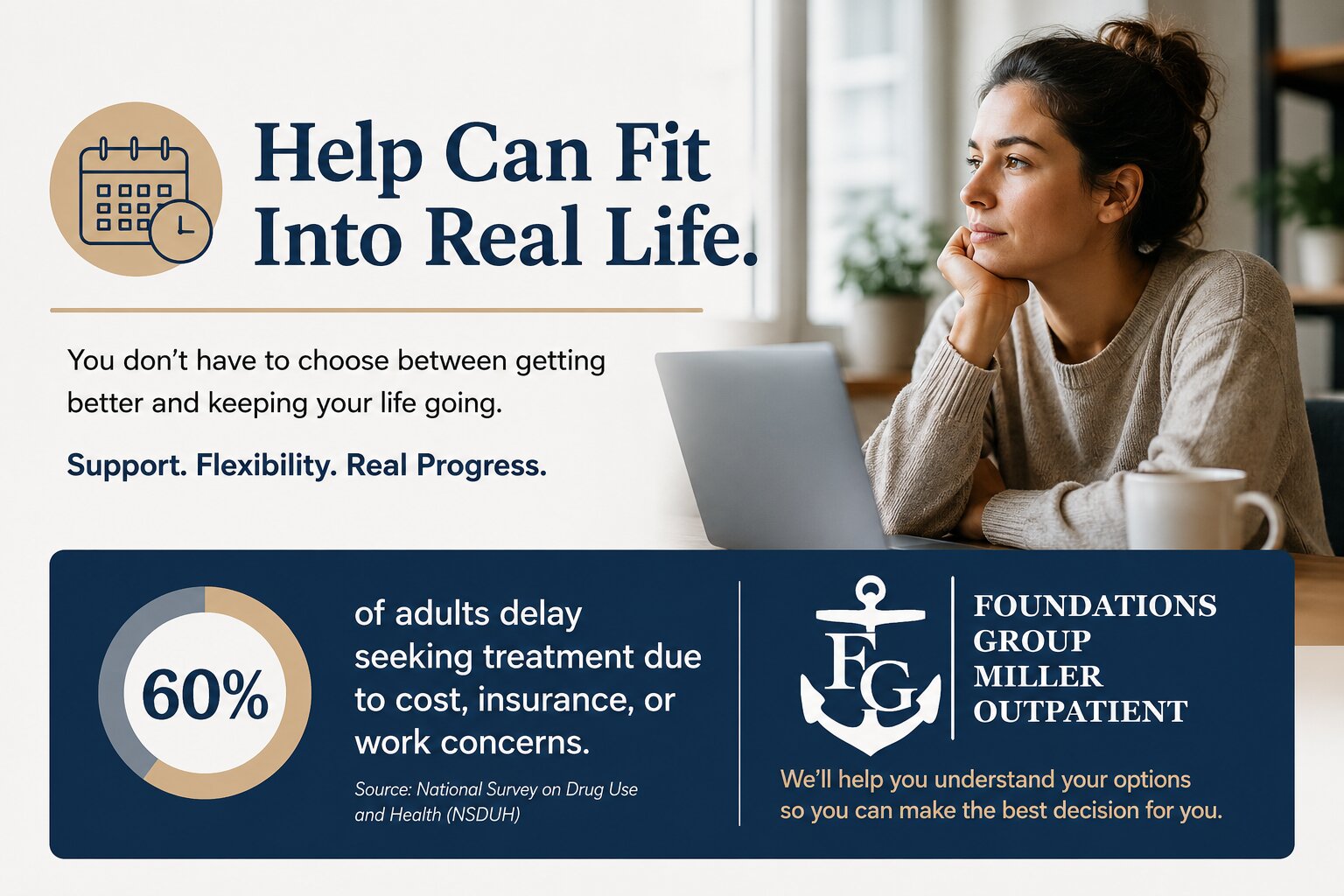
Step 5: Consider How Treatment Fits Into Real Life
One of the biggest misconceptions about treatment is that it requires disappearing from normal life.
People often picture live-in facilities, months away from home, or complete separation from work and family.
While some people do need round-the-clock support, many don’t.
Treatment exists on a spectrum.
Some people benefit from weekly therapy.
Others need more structure and accountability.
Many individuals find that structured daytime care provides a middle ground between minimal support and full residential treatment.
Depending on scheduling, employer flexibility, and individual circumstances, some people continue working in modified ways while participating in treatment.
The goal isn’t necessarily to stop living your life.
The goal is to improve your ability to live it.
Step 6: Focus on the Next Three Months, Not Just Next Week
Most treatment decisions get stuck because people focus exclusively on immediate inconveniences.
Can I fit this into next week’s schedule?
What about meetings?
What about projects?
What about childcare?
These concerns are valid.
But they don’t tell the whole story.
Try asking a different question:
What happens if nothing changes?
Where will you be three months from now?
Six months from now?
A year from now?
Sometimes people realize they’ve been waiting for a perfect time that never arrives.
There’s always another project.
Another deadline.
Another reason to postpone taking care of themselves.
The perfect time rarely shows up.
Progress usually starts when someone decides they’re tired of waiting for it.
Step 7: Let Someone Help You Sort Through the Details
Many people think they need all the answers before reaching out.
They want to understand costs, schedules, insurance coverage, treatment options, and timelines before making a call.
In reality, most people start with questions.
Lots of questions.
That’s completely normal.
A quality admissions team should be able to:
- Verify insurance benefits
- Explain coverage
- Discuss scheduling options
- Answer financial questions
- Help determine appropriate levels of care
- Clarify next steps
Getting information isn’t a commitment.
It’s simply gathering the facts you need to make a decision.
The Decision Is Usually About More Than Money
By the time many people finally call, they’ve already spent months researching.
They’ve compared options.
Read reviews.
Calculated costs.
Imagined every possible outcome.
What they’re often wrestling with isn’t cost.
It’s permission.
Permission to prioritize themselves.
Permission to get support.
Permission to believe things could be better than they are now.
If you’re sober curious, questioning your relationship with alcohol, struggling emotionally, or wondering whether additional support could improve your life, you don’t need to have everything figured out.
You don’t need certainty.
You don’t need a crisis.
You simply need enough information to take one step forward.
For many people researching PHP cost with insurance, the biggest surprise isn’t discovering how much treatment costs.
It’s discovering that help may be far more accessible than they imagined.
Frequently Asked Questions
Can insurance reduce the cost of treatment?
Yes. Many insurance plans provide coverage for behavioral health and substance use treatment. The amount covered depends on your specific plan, deductible, and whether the provider is in-network.
How do I find out what my insurance covers?
The easiest approach is to contact a treatment provider and request a benefits verification. They can often help explain your coverage and estimated costs.
Can I work while participating in structured daytime care?
Some people continue working while receiving treatment, depending on their schedule, employer flexibility, and clinical needs. This is something that can be discussed during the admissions process.
What if I can’t take weeks off from work?
Many people seeking treatment share this concern. Treatment plans vary, and there may be options that provide meaningful support while allowing you to maintain certain responsibilities.
Is treatment only for people with severe substance use problems?
No. Many individuals seek treatment because they recognize patterns they want to change before those patterns become more serious.
What if I’m not sure I need treatment?
Uncertainty is common. Reaching out for information doesn’t obligate you to start treatment. Sometimes a conversation is simply a way to better understand your options.
Will my employer know I’m receiving treatment?
Treatment is confidential. Any decisions about sharing information with your employer are typically yours to make unless specific workplace requirements apply.
Is it worth calling if I’m mostly concerned about cost?
Absolutely. Many people discover their actual financial responsibility is very different from what they expected. A simple insurance verification can provide clarity and help you make an informed decision.
Call 774-252-6966 or visit our day treatment program services to learn more about our Day treatment program services Massachusetts.