

There’s a kind of heartbreak that happens quietly in family homes before most people ever see it.
It’s 6:45am.
Your teen is already overwhelmed.
Maybe they’re crying. Maybe they’re yelling. Maybe they’re frozen under a blanket staring at the wall while the clock keeps moving.
You’ve tried encouragement. Tough love. Gentle conversations. Consequences. Keeping them home. Pushing harder. Backing off.
Nothing seems to work consistently anymore.
And somewhere inside all of it, a terrifying thought starts forming:
“What if this is getting bigger than we can handle?”
Many parents searching online for answers feel trapped between two impossible choices:
Keep forcing school every morning until things explode… or wait until the situation becomes severe enough for the ER.
But there is often a middle ground.
For some families, exploring structured daytime mental health support can provide meaningful care before anxiety turns into full emotional crisis.
And if you’re exhausted, scared, or questioning yourself right now, please know this:
You are not failing your child because you don’t automatically know how to fix this.
School Refusal Usually Starts Quietly
Very few teens wake up one morning and suddenly refuse school out of nowhere.
Parents often describe a slow progression first.
Stomachaches before class.
Panic at night.
Difficulty sleeping.
Frequent headaches.
Emotional meltdowns on Sunday evenings.
Increasing irritability.
Isolation from friends.
Missing “just one day” that slowly turns into many.
At first, families often assume it’s stress or burnout. And sometimes it is—for a while.
But anxiety has a way of growing quietly underneath daily life until even small responsibilities start feeling impossible to the nervous system.
This is why teen school refusal anxiety can become so emotionally confusing for parents. From the outside, school may still look manageable. But internally, your teen may feel like they’re being asked to walk into danger every morning.
That fear feels very real to them, even if they cannot fully explain it.
Parents Often Feel Stuck Between Compassion and Panic
One of the hardest parts of this experience is that there’s no obvious “correct” parenting response.
If you push too hard, your child may completely shut down emotionally.
If you ease pressure too much, you worry you’re reinforcing avoidance.
So every morning starts feeling loaded with fear and second-guessing.
Should we make them go?
Should we let them stay home?
Should we call the school again?
Are we helping—or accidentally making things worse?
Parents carry enormous guilt in these situations.
Many begin questioning themselves constantly:
“Did we miss signs?”
“Did we cause this somehow?”
“Are they manipulating us?”
“Are we overreacting?”
Meanwhile, the entire household starts revolving around anxiety.
Siblings notice the tension. Parents lose sleep. Work schedules get disrupted. Marriages become strained under the pressure of trying to hold everything together while also protecting a child who seems emotionally overwhelmed all the time.
That level of stress wears families down quietly.
And often, parents feel deeply alone in it.
Anxiety Can Look Like Defiance From the Outside
This is one reason these situations become so emotionally charged.
A teen with severe anxiety may appear angry, avoidant, oppositional, or “lazy” from the outside. But internally, many are operating from panic and emotional overload—not indifference.
Imagine your nervous system sounding an alarm every single morning before school.
Your chest tightens.
Your stomach hurts.
Your thoughts race.
You feel trapped.
You start believing everyone is watching you, judging you, or expecting something impossible from you.
Now imagine trying to focus on geometry while your body feels like it’s fighting for survival.
That’s closer to what severe anxiety can feel like for some teens.
And many of them hate that they can’t “just get over it.”
Parents sometimes tell us:
“They actually want to do well.”
“They feel embarrassed missing school.”
“They cry because they know they’re falling behind.”
That shame matters.
A lot of teens experiencing school-related anxiety already feel like they’re disappointing everyone around them.
The ER Isn’t the Only Place Families Can Turn
Many families don’t realize there are levels of support between weekly therapy and emergency hospitalization.
They assume:
“If my child isn’t actively unsafe, we should just wait this out.”
Or:
“If it gets worse, I guess we’ll end up in the ER.”
But emotional suffering doesn’t have to reach catastrophic levels before a teen deserves more support.
Sometimes anxiety becomes too disruptive for once-a-week therapy alone to realistically stabilize. That does not automatically mean a teen needs round-the-clock care or inpatient hospitalization.
For some families, structured daytime support offers another path.
This type of care can provide:
- More frequent therapeutic support
- Emotional stabilization during daytime hours
- Psychiatric support when appropriate
- Group connection with peers
- Family involvement
- Help rebuilding routines gradually and safely
Importantly, many teens return home at night, which can reduce fear around treatment and help families stay connected during the healing process.
That emotional distinction matters more than many people realize.
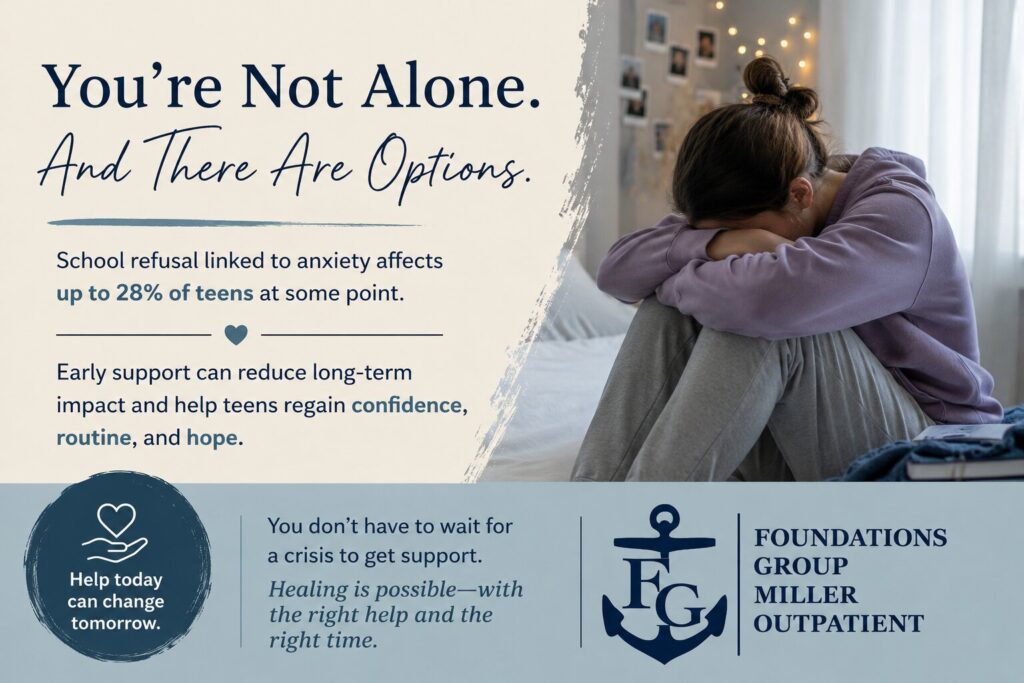
The Goal Isn’t Just Attendance
This is incredibly important.
Parents understandably become focused on getting their child back into school because the consequences of missed attendance feel terrifying.
But school refusal is often a symptom—not the entire problem.
The deeper goal is helping your teen feel emotionally regulated enough to function again.
Because untreated anxiety tends to spread into every area of life over time.
Friendships suffer.
Sleep deteriorates.
Confidence collapses.
Isolation grows.
Depression sometimes follows.
Family relationships become strained under constant stress.
Eventually, many teens stop seeing themselves as capable altogether.
That hopelessness can become dangerous emotionally if left unsupported for too long.
This is why treatment conversations should focus on safety, stabilization, and support—not simply “fixing behavior.”
Teens usually respond better when they feel understood instead of controlled.
Families Need Support Too
Parents often become so focused on helping their child that they completely neglect their own emotional exhaustion.
But living in ongoing crisis mode changes people.
Many parents become hypervigilant. They dread mornings. Their nervous systems start reacting before the day even begins. Some describe feeling physically anxious every Sunday night because they know Monday morning will likely become another emotional battle.
That kind of chronic stress matters.
You are carrying grief, fear, confusion, and responsibility simultaneously.
And many parents quietly feel ashamed admitting how overwhelmed they’ve become because they think they’re supposed to handle this perfectly.
You are not supposed to know exactly how to navigate every mental health crisis alone.
Sometimes families need guidance, structure, and support too.
That does not mean you failed your child.
It means this became heavy.
Improvement Often Happens Slowly
One of the hardest truths for families is that recovery from severe anxiety is rarely immediate.
Parents understandably want reassurance:
“When will they go back to normal?”
“When will mornings stop feeling like this?”
But healing usually happens in smaller moments first.
Your teen sleeps through the night again.
They leave the house voluntarily.
They reconnect with friends.
They tolerate difficult conversations longer.
They begin imagining a future again instead of just surviving the day.
Those moments matter deeply.
Even if progress feels uneven at times.
Anxiety recovery is often less about “flipping a switch” and more about helping the nervous system slowly relearn safety.
That process takes patience, support, and often more structure than families can provide alone at home.
You Do Not Need to Wait Until Things Completely Collapse
Many parents wait far too long before reaching out because they fear being dramatic or overreacting.
But emotional suffering deserves attention before it becomes catastrophic.
If your teen’s anxiety is affecting daily functioning, school attendance, sleep, emotional stability, or your family’s ability to function normally, it’s okay to ask for more support now—not later.
That is not weakness.
That is responsive parenting.
And for many families, exploring structured daytime mental health care creates a bridge between weekly therapy and emergency intervention, offering meaningful support while still allowing teens to remain connected to home and family life.
Frequently Asked Questions
Is school refusal always caused by anxiety?
No. School refusal can involve anxiety, depression, bullying, trauma, learning differences, social struggles, family stress, or multiple overlapping issues. Anxiety is one of the most common causes, but not the only one.
How do I know if my teen’s anxiety is becoming serious?
Signs may include frequent panic, physical symptoms before school, emotional shutdown, increasing isolation, inability to attend classes consistently, sleep disruption, or severe distress connected to school or social situations.
Should we force our teen to attend school?
Every situation is different. For some teens, pushing harder can increase panic and emotional shutdown. Families often benefit from professional guidance to determine the safest and most supportive approach.
When should parents seek more intensive support?
If anxiety is disrupting daily functioning, family stability, emotional regulation, or school attendance significantly, additional support may help before things escalate further.
Does needing structured care mean my child is “severe”?
Not necessarily. Some teens simply need more consistent support than weekly therapy alone can provide. Seeking additional help early can sometimes prevent deeper crises later.
Can anxiety really cause physical symptoms?
Yes. Anxiety can create nausea, headaches, dizziness, panic attacks, shaking, chest tightness, fatigue, stomach pain, and other very real physical symptoms.
What if my teen refuses treatment too?
That’s common. Many teens feel scared, ashamed, overwhelmed, or defensive. Treatment conversations often go better when approached with curiosity, calmness, and reassurance instead of punishment or ultimatums.
What’s the difference between burnout and teen school refusal anxiety?
Burnout and anxiety often overlap. Burnout may involve emotional exhaustion and overwhelm, while teen school refusal anxiety usually includes significant fear, panic, avoidance, or distress connected to attending school itself.
Will my child fall permanently behind?
Most parents fear this deeply. But mental health stabilization often needs to happen before academic recovery becomes sustainable. With support, many teens gradually rebuild confidence, routines, and school participation over time.
What if we’ve already tried therapy?
That doesn’t mean hope is gone. Sometimes teens simply need a different level of support, more consistency, or a broader treatment approach involving family care, psychiatric support, and structured daytime intervention.
Call (774) 252-6966 or visit our Day treatment program services to learn more about our Day treatment program services in your area.