

Some people hit a wall.
Others become experts at walking around it.
They keep showing up to work. They answer emails. They make meetings. They hit deadlines. They smile when they’re supposed to smile.
From the outside, everything looks stable.
Inside, it’s a different story.
If you’ve been thinking, “I need real help, but I can’t take weeks off work,” you’re not alone. In fact, many of the people who eventually reach out for support have spent months—or years—trying to convince themselves they can manage a little longer.
At Foundations Group Miller Outpatient, we’ve met professionals, parents, business owners, healthcare workers, teachers, and executives who all shared a similar concern. They weren’t avoiding help because they didn’t care about their mental health. They were trying to protect everything else.
Their careers.
Their families.
Their responsibilities.
Their identities.
That’s why options like half-day outpatient treatment exist. Because sometimes the people who need support the most are the people carrying the most weight.
The Exhaustion Nobody Sees
One client described depression as feeling like they were dragging a weighted blanket through every part of their day.
Nothing looked wrong from the outside.
They still got dressed.
Still went to work.
Still attended family events.
Still paid bills.
But every task felt harder than it should.
Depression has a way of making ordinary life feel unusually heavy. The simplest decisions become exhausting. Small setbacks feel overwhelming. Activities that once brought enjoyment start feeling flat or meaningless.
High-functioning people often become masters at hiding this reality.
They know how to perform.
They know how to push through.
They know how to appear okay.
But eventually, constantly pretending becomes its own form of exhaustion.
Many people don’t realize how much energy they’re spending just maintaining the appearance of normal until they finally experience some relief.
Panic Doesn’t Always Look the Way People Expect
Movies have done a poor job of teaching people what panic actually looks like.
Most people imagine someone hyperventilating in a dramatic moment.
Sometimes panic attacks look like that.
Other times they look like:
- Sitting in your car for fifteen minutes before walking into work
- Leaving meetings to “grab coffee” because your heart is racing
- Waking up at 3 a.m. convinced something terrible is about to happen
- Constantly scanning for worst-case scenarios
- Feeling physically sick before routine responsibilities
- Being unable to relax even when nothing is wrong
Many high-functioning adults normalize these experiences.
They assume everyone feels this way.
Or they convince themselves it’s simply part of being successful.
It isn’t.
Living with constant anxiety and panic is like driving with one foot on the gas and one foot on the brake. You can move forward for a while, but eventually something starts wearing down.
Usually, that something is you.
The Hidden Cost of Being “The Reliable One”
Every family has one.
Every workplace has one.
The person everyone depends on.
The problem-solver.
The responsible one.
The person who always figures things out.
If that’s been your role for years, seeking help can feel surprisingly uncomfortable.
People often assume high-functioning individuals avoid treatment because they’re in denial.
That’s usually not true.
Many know exactly how much they’re struggling.
The challenge is that they’ve built an identity around being dependable.
Admitting they need support can feel like they’re letting people down.
But here’s something worth considering:
The people who care about you would probably rather see you get help than watch you silently suffer.
Many high-functioning adults spend years protecting everyone else from their struggles while nobody realizes how much they’re carrying.
Functioning Isn’t the Same Thing as Thriving
One of the most damaging beliefs we hear is this:
“If things were really bad, I wouldn’t be functioning.”
At first glance, it sounds logical.
But mental health doesn’t work that way.
You can be productive and depressed.
You can be successful and anxious.
You can earn promotions while experiencing panic attacks.
You can look completely fine while feeling emotionally exhausted.
Functioning is often the minimum requirement of adult life.
Thriving is something entirely different.
Many people confuse survival with wellness because they’ve been surviving for so long.
The goal isn’t simply to continue functioning.
The goal is to actually feel like yourself again.
Why Waiting Rarely Makes Things Better
High performers are often excellent at postponing their own needs.
They tell themselves:
“I’ll deal with this after this project.”
“Things will calm down after the holidays.”
“Next month will be less stressful.”
“I just need to push through a little longer.”
Months pass.
Sometimes years.
The problem is that life rarely slows down on its own.
There is always another project.
Another deadline.
Another responsibility.
Another reason to wait.
Depression and panic often become more entrenched the longer they’re ignored.
The coping mechanisms that once worked stop working.
The energy reserves shrink.
The emotional burnout grows.
Many people eventually reach a breaking point not because their symptoms suddenly appeared, but because they spent too long carrying them alone.
There Is More Than One Way to Get Help
When people imagine getting serious help for mental health challenges, they often picture extreme scenarios.
They imagine disappearing for months.
Taking extended leave.
Putting life completely on hold.
For some individuals, intensive support is absolutely necessary.
But many people exist in a different situation.
They’re struggling.
They’re exhausted.
They know they need more support than weekly therapy alone.
Yet they still have responsibilities they can’t simply walk away from.
This is where many people discover there are options between doing nothing and completely stepping away from life.
For individuals seeking mental health treatment while working, finding the right level of support often means identifying a program that respects both realities: your need for care and your existing responsibilities.
Sometimes the answer isn’t choosing between work and treatment.
It’s finding a way to make both possible.
The Fear Nobody Talks About
Many people are afraid treatment won’t work.
But another fear shows up just as often.
They’re afraid it will.
Because if treatment helps, they can no longer tell themselves they’re too busy to address what’s happening.
They’ll have to confront the reality that they’ve been suffering longer than necessary.
That realization can be uncomfortable.
But it can also be freeing.
You don’t have to prove how much pain you’re in before seeking support.
You don’t need permission.
You don’t need a crisis.
You don’t need to lose everything first.
The idea that people must hit rock bottom before getting help has prevented countless individuals from reaching out sooner.
You Don’t Have to Earn the Right to Feel Better
This may be the most important thing in this article.
You do not need to justify your struggle.
You do not need to compare your pain to someone else’s.
You do not need to wait until you’re completely overwhelmed.
If depression is affecting your life, it matters.
If panic attacks are affecting your life, it matters.
If you’re exhausted from carrying everything alone, it matters.
The people who often need support the most are the people who have become experts at hiding how much they need it.
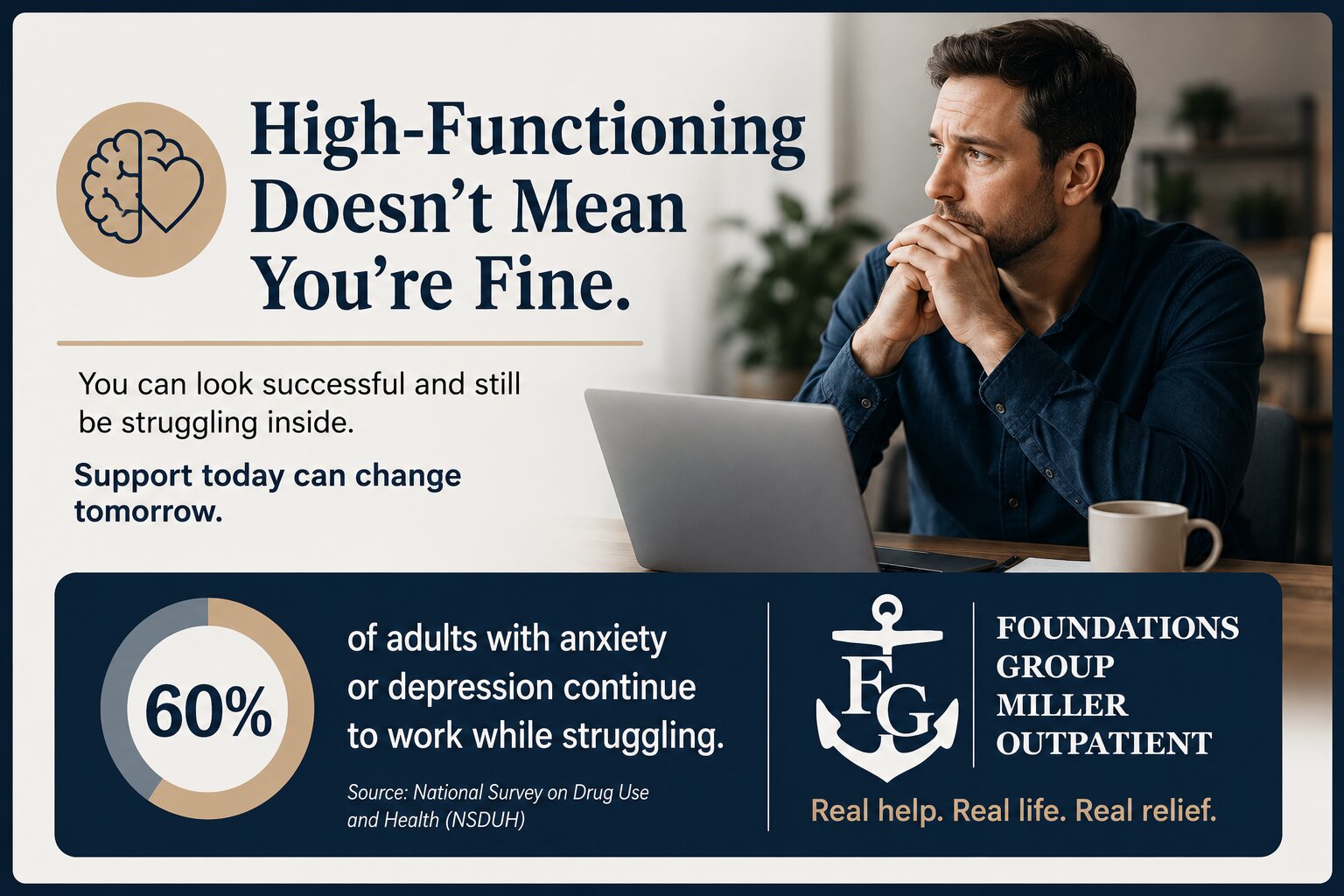
Being high-functioning doesn’t mean you’re fine.
It often means you’ve become exceptionally skilled at suffering quietly.
You deserve more than survival mode.
You deserve support.
Frequently Asked Questions
Can I get help for depression without taking weeks off work?
In many cases, yes. Some treatment options are designed specifically for people who need more support than traditional therapy while continuing to manage work and family responsibilities.
What if my symptoms aren’t severe enough for intensive treatment?
Many people wait until symptoms become overwhelming before seeking help. If depression, anxiety, or panic attacks are significantly affecting your quality of life, it’s worth having a professional assessment to determine what level of support may be appropriate.
Will my employer know I’m receiving treatment?
Mental health treatment is confidential. Depending on your situation, you may choose to discuss scheduling needs with your employer, but your treatment information is generally protected by privacy laws.
How do I know if I need more than weekly therapy?
If symptoms continue despite therapy, if you’re struggling to function day-to-day, or if you’re experiencing worsening depression, anxiety, or panic attacks, additional support may be beneficial.
What if I’ve been struggling for years?
Many people live with depression and anxiety for years before seeking comprehensive help. The length of time you’ve struggled doesn’t determine whether improvement is possible.
Can panic attacks happen even if I’m successful at work?
Absolutely. Professional success does not protect someone from anxiety disorders, panic attacks, depression, or burnout. Many high-achieving individuals quietly struggle with mental health challenges.
What if I feel guilty asking for help?
Feeling guilty is common, especially among people who are used to taking care of others. Seeking help isn’t selfish. It’s often one of the most responsible decisions a person can make for themselves, their family, and their future.
Call 774-252-6966 or visit our half-day outpatient treatment services to learn more about our half-day outpatient treatment services.