

You’re still getting things done.
That’s what makes this so easy to ignore.
From the outside, your life works. Inside, it’s starting to feel like you’re holding everything together with tension and caffeine.
If you’ve quietly found yourself looking for support that goes beyond weekly sessions, you’re not overthinking it. You’re noticing something real.
You’ve Mastered Looking Okay
We see this version of you all the time.
You show up early. You respond quickly. You don’t miss deadlines. People trust you.
You’ve built a life where things don’t fall apart easily.
But here’s the part no one sees:
How much effort it takes to keep it that way.
High-functioning doesn’t mean things are easy.
It means you’ve gotten really good at hiding the cost.
The Pressure Isn’t Loud—It’s Constant
It’s not a breakdown. It’s a slow burn.
You’re not collapsing—you’re carrying.
- Carrying stress that doesn’t turn off
- Carrying thoughts that don’t settle
- Carrying expectations you can’t step away from
And because nothing is visibly “wrong,” you don’t give yourself permission to call it what it is.
Struggle.
So instead, you normalize it.
The Moment Weekly Support Stops Feeling Like Enough
There’s usually a shift.
At first, weekly therapy helps. You feel a little lighter after sessions. A little more aware. A little more in control.
But then life keeps happening.
Stress doesn’t wait for your next appointment.
Emotions don’t stay contained in a 50-minute window.
You start noticing something uncomfortable:
You’re spending most of the week trying to get back to how you felt for maybe… an hour.
That gap starts to matter.
Not because therapy isn’t helpful—but because you need more continuity than it can give on its own.
Why “Just Push Through” Starts to Backfire
This is where high-functioning people get stuck.
You’ve always been able to push through. That’s your strength.
Until it isn’t.
Because pushing through doesn’t resolve anything—it just delays the impact.
It looks like this:
- You ignore the stress → it builds
- You override your limits → you burn out
- You stay productive → but feel disconnected
At some point, pushing through stops being resilience.
It becomes survival.
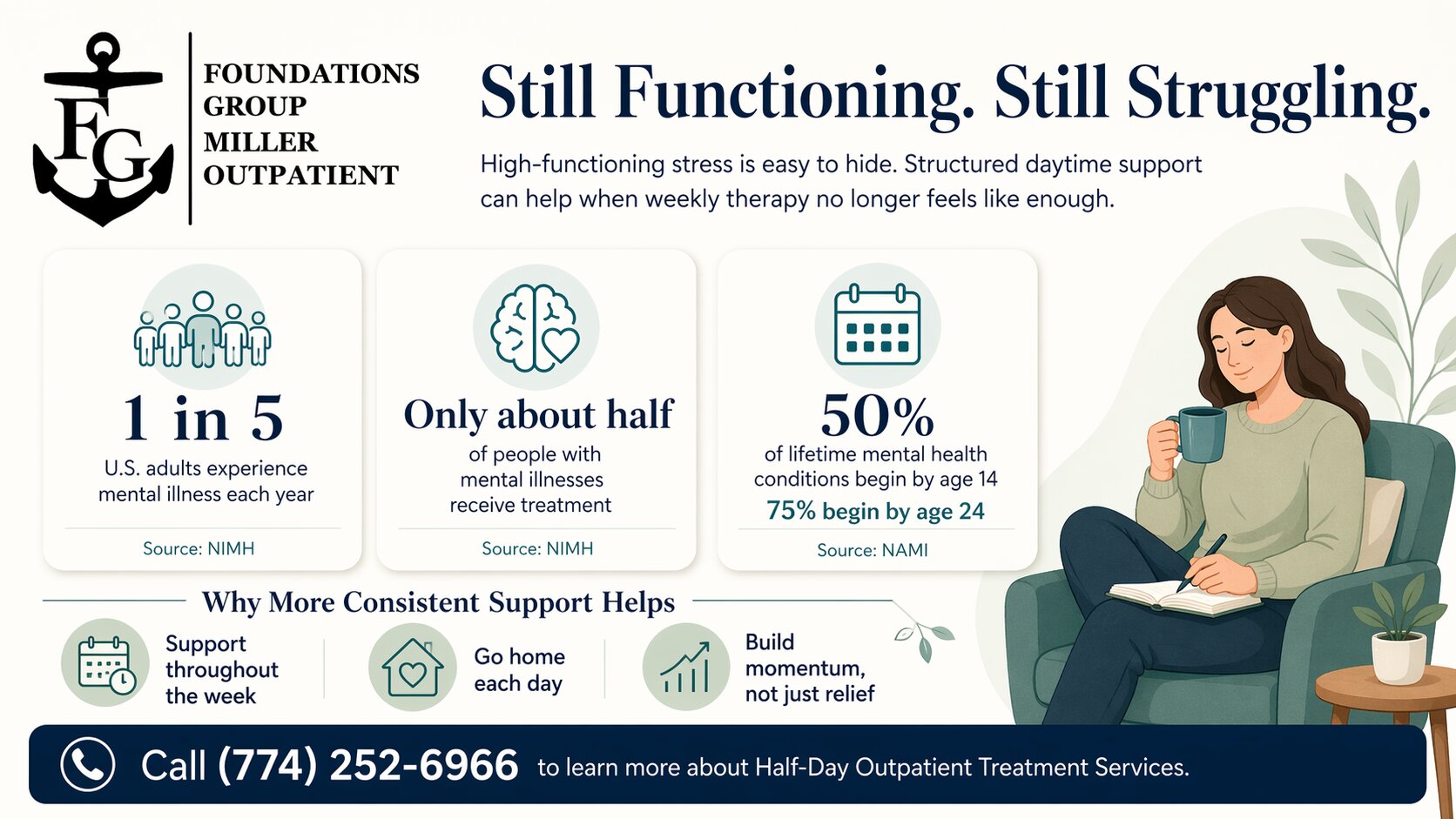
The Middle Ground Most People Don’t Know Exists
There’s a quiet assumption that your only options are:
- Keep managing it on your own
- Or step away from your life completely
That’s not true.
There’s a middle space—one that doesn’t require you to disappear from your responsibilities, but also doesn’t leave you carrying everything alone.
This is where structured daytime care comes in.
Not all day. Not all-consuming. But consistent enough to actually support you.
For many people, it’s the first time support feels like it’s keeping up with their life instead of lagging behind it.
What Changes When Support Matches Your Reality
When people move into a more consistent, structured rhythm of care—even just part of the day—something shifts.
Not overnight. But noticeably.
We’ve seen people:
- Feel less mentally scattered because support is spread throughout the week
- Stop “resetting” every session and start building momentum
- Have space to process things as they happen, not days later
- Experience relief—not because everything is fixed, but because they’re not holding it alone
One of the most common things we hear?
“I didn’t realize how much I was carrying until I didn’t have to carry it by myself anymore.”
The Part You Don’t Say Out Loud
There’s usually a quiet thought underneath all of this:
“I should be able to handle this.”
You’ve built an identity around being capable. Reliable. Strong.
So needing more support feels like a contradiction.
But here’s the truth:
Needing more support doesn’t mean you’re less capable.
It means you’ve reached the limit of doing it alone.
And that’s not failure—that’s awareness.
A Different Kind of Strength
Real strength isn’t just pushing through.
It’s recognizing when pushing through isn’t working anymore.
It’s choosing something that actually supports you—even if it feels unfamiliar at first.
It’s letting go of the idea that you have to earn help by getting worse.
You don’t.
If anything, the earlier you respond to what you’re feeling, the less you have to unravel later.
If You’re Quietly Reaching for More
If you’ve made it this far, there’s a reason.
Something in you is noticing the gap—the space between “functioning” and actually feeling okay.
That matters.
And if you’ve been searching for something that feels like more than weekly therapy, that’s not you being dramatic.
That’s you recognizing your needs have changed.
You don’t have to ignore that.
You can explore options that fit your life instead of disrupting it completely.
If you want to understand what that could look like, you can learn more about treatment options in your area through this structured daytime program.
FAQ: For the Ones Who Are Still Functioning (But Struggling)
If I’m still managing my responsibilities, do I really need more support?
Functioning doesn’t mean you’re okay—it means you’re coping. If it’s taking more effort than it should, or starting to feel unsustainable, that’s worth paying attention to.
Is it normal to feel this overwhelmed without a clear “reason”?
Yes. Not all mental health strain comes from one obvious event. Sometimes it’s the accumulation of stress, pressure, and emotional load over time.
What if I feel like I should just be able to handle it?
A lot of high-functioning people feel this way. But needing more consistent support isn’t a failure—it’s a sign you’ve outgrown doing it alone.
Will getting more support disrupt my daily life?
Not necessarily. Some care options are designed specifically to fit into your schedule, offering structure without requiring you to step away completely.
How do I know it’s time to try something different?
If you’re thinking about it consistently, that’s usually the sign. Especially if what you’re currently doing no longer feels like enough.
What if I try this and it doesn’t work?
Then you adjust. Support isn’t one-size-fits-all. The goal isn’t perfection—it’s finding something that actually helps you feel more steady and supported.
You Don’t Have to Prove You’re Struggling to Get Support
You don’t need to break down to deserve help.
You don’t need to lose control before you’re allowed to reach for something more.
And you don’t have to keep holding everything together just to prove that you can.
If you’re ready to explore a different kind of support—one that meets you where you are—you can take that step.
Call (774) 252-6966 or visit half-day outpatient treatment services to learn more about our half-day outpatient treatment services in Massachusetts.