

You haven’t missed a deadline.
You haven’t scared your family.
You haven’t “lost everything.”
But you’re drinking more than you admit. Or using more than you planned.
And the gap between how you look and how you feel is getting wider.
If you’re a professional in Falmouth trying to keep your life intact while quietly struggling, this is for you.
You may have already searched options and found programs like this full-day structured support option in Falmouth. And maybe you closed the tab.
Because your first thought wasn’t, “Finally.”
It was, “There’s no way I can disappear for 30 days.”
Let’s slow that down.
You’re Not a Stereotype. You’re Just Tired.
High-functioning addiction is sneaky.
It doesn’t look like chaos.
It looks like competence.
You:
- Show up to work.
- Pay your bills.
- Return emails.
- Keep your family schedule running.
And then you collapse into whatever numbs the edge off.
You tell yourself you’re managing it. And technically, you are.
But management isn’t the same thing as peace.
If you’re honest, it feels more like maintenance. Like constantly tightening bolts on a machine that’s overheating underneath.
You’re not failing.
You’re white-knuckling.
The Real Fear: Losing Control of Your Reputation
For professionals, the biggest fear isn’t detox.
It’s exposure.
- What if my employer finds out?
- What if a colleague sees my car parked outside a treatment center?
- What if this goes on my record?
- What if clients lose trust?
These fears are real. And they deserve respect.
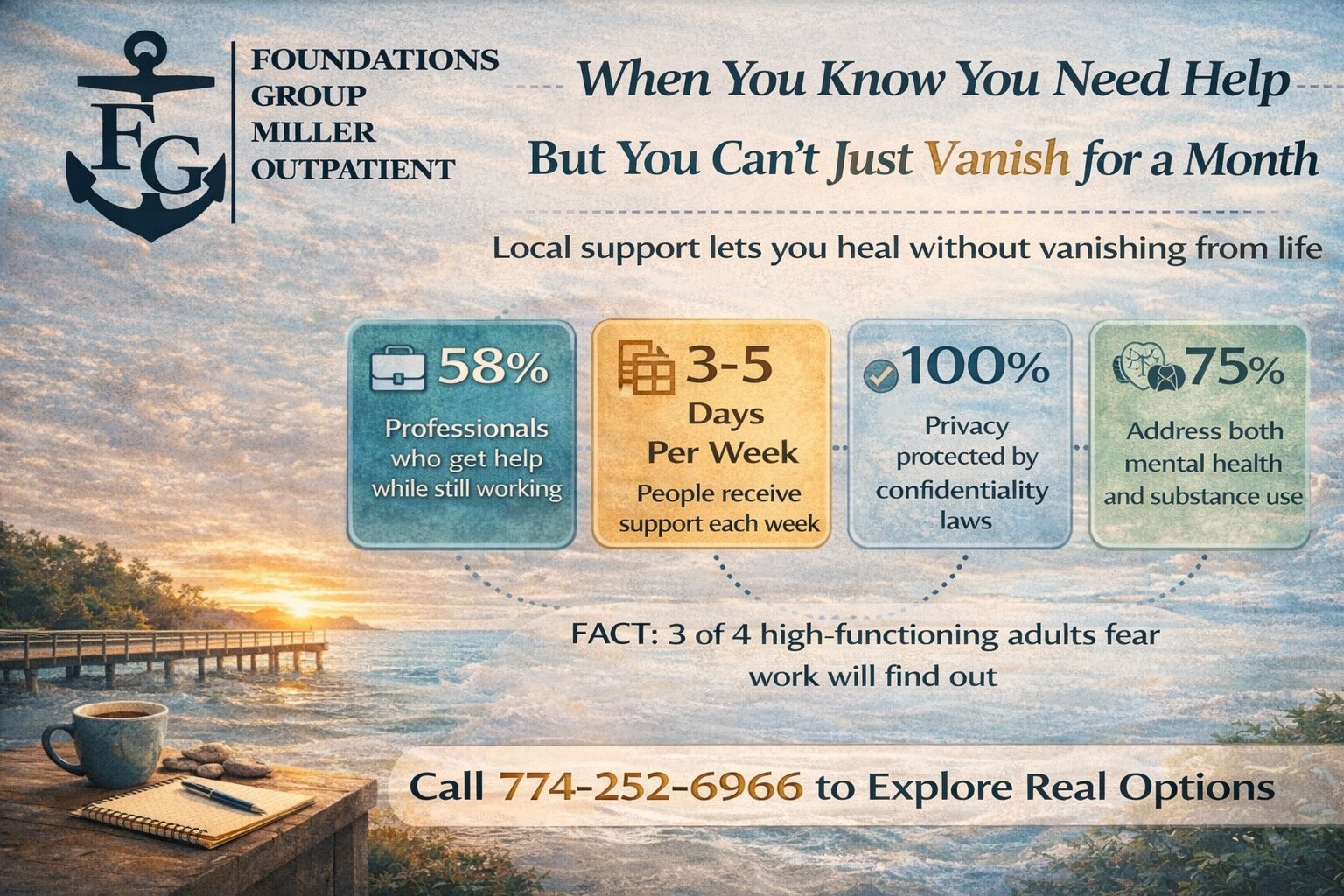
The truth is, structured daytime care is often built with discretion in mind. People in these programs are teachers, nurses, executives, small business owners, contractors, parents. People with responsibilities.
You are not the only one trying to get better without torching your entire identity.
You Don’t Have to Blow Up Your Life to Fix It
There’s a common belief that if you’re going to “do this right,” you have to disappear into live-in treatment.
For some people, round-the-clock support is necessary. But many professionals are in a different category. They’re still functioning. Still employed. Still showing up.
They just can’t keep living like this.
That’s where something like outpatient day treatment becomes a real option.
It offers:
- Structured therapy multiple days a week
- Accountability
- Group work with other adults
- Individual counseling
- A focused environment to address both mental health and substance use
But you go home at night.
You don’t vanish from your kids’ lives.
You don’t shut down your business.
You don’t disappear from your community in Falmouth.
You step into support during the day—and then step back into your life with more stability.
For a lot of high-functioning adults, that balance is the difference between “I can’t do this” and “Okay… maybe I can.”
You Might Be Closer to the Edge Than You Think
You don’t have to be crashing to be struggling.
You might need more structured help if:
- You plan your evenings around when you can drink or use.
- You’ve tried to cut back and keep sliding back.
- You wake up at 3am anxious and wired.
- You’re more irritable than you used to be.
- You’re constantly promising yourself “tomorrow will be different.”
High-functioning addiction often hides behind success.
But success doesn’t cancel suffering.
The Hidden Cost of “Handling It Yourself”
Let’s talk about the part no one sees.
The mental math.
How much is left.
How early is too early.
Whether anyone can smell it.
Whether you said too much.
That constant internal calculation drains you.
It costs:
- Emotional presence with your partner.
- Patience with your kids.
- Focus in meetings.
- Confidence in yourself.
Even if no one else knows, you know.
And that quiet self-betrayal adds up.
At some point, the bigger risk isn’t treatment.
It’s continuing exactly like this.
What Structured Daytime Care Actually Feels Like
It’s not a dramatic breakdown.
It’s structure.
You walk into a day designed around recovery. Not chaos. Not shame. Not lectures.
You get:
- Time to slow down
- Therapy that goes deeper than surface-level coping
- Honest conversations with other adults who look “fine” on the outside too
- Tools for managing stress without reaching for a substance
You also get something unexpected.
Relief.
Relief from pretending.
Relief from secrecy.
Relief from trying to out-think your own behavior.
In a program like this, you’re not stripped of your identity. You’re given space to examine what’s underneath the pressure.
You learn how to stabilize without abandoning your life.
That matters.
“But What If I’m Not Bad Enough?”
This is the question almost every high-functioning professional asks.
You compare yourself to extremes.
“I’m not drinking in the morning.”
“I haven’t lost my job.”
“I’m not getting arrested.”
But here’s a different question:
Are you okay?
Not “are you surviving?”
Not “are you technically functioning?”
Are you okay in your own skin?
If your substance use is:
- Increasing
- Harder to control
- Taking up more mental space
- Affecting your mood or sleep
You don’t have to wait for it to implode.
You’re allowed to get help before the crash.
Staying Local Matters
If you live or work in Falmouth, proximity matters.
The closer support is, the more realistic it becomes.
Instead of imagining some far-away, disruptive scenario, you can look at real options for treatment in Falmouth.
Close to home.
Close to your routines.
Close to the life you’re trying to preserve.
Recovery doesn’t have to mean exile.
Sometimes it means recalibration.
FAQ: What Professionals Often Ask Before Reaching Out
Will my employer find out?
Programs are confidential. Your participation is protected under privacy laws. Many professionals take medical leave when needed, but not everyone does. A conversation with the admissions team can clarify your specific situation without committing you to anything.
Can I keep working while attending?
Many people in structured daytime programs adjust their schedules rather than quitting their jobs. Some shift hours temporarily. Others use leave time. It depends on your workload and flexibility—but disappearing completely is not always required.
Is this only for “severe” addiction?
No. Many participants are high-functioning adults who caught the problem before it escalated further. If you’re thinking about getting help, that alone is worth paying attention to.
What if I also struggle with anxiety or depression?
It’s common for mental health and substance use to overlap. Structured daytime care is designed to address both at the same time—because separating them rarely works long term.
What if I start and realize it’s too much?
Treatment isn’t a trap. It’s a process. If something isn’t the right fit, it can be adjusted. The goal is stability—not punishment.
I’ve tried therapy before. How is this different?
Weekly therapy is valuable. But if you’re stuck in cycles, more immersive support can help interrupt patterns. Being in a focused therapeutic environment multiple days a week changes the momentum.
You don’t have to wait until your life collapses to justify support.
You don’t have to prove you’re struggling “enough.”
If you’re exhausted from performing competence while privately unraveling, that’s reason enough to explore something different.
Call 774-252-6966 or visit our outpatient day treatment services in Falmouth, MA to learn more about our outpatient day treatment services in Falmouth, MA.
You don’t need to disappear for 30 days.
You just need to stop doing this alone.