

You already know something has to change.
Maybe you’ve tried to manage it on your own. Maybe things have slowly unraveled. Maybe it wasn’t slow at all.
Now you’re here — not in denial, not pretending. Just scared.
At Foundations Group Miller Outpatient, we meet people in that exact space every day. If you’ve been searching for a day treatment program, what you’re really asking is this:
What will my life look like once I start?
Let’s slow it down and walk through it — honestly.
The First Morning: Walking In With a Thousand Thoughts
The first day is rarely dramatic.
It’s usually quiet. Internal. Loud only inside your head.
You might wake up early because you didn’t sleep much. You might sit in your car for a minute before going inside. You might wonder if everyone will somehow “know” everything about you.
They won’t.
When you arrive, you’re welcomed, oriented, and guided through what the day will look like. We focus on reducing uncertainty because uncertainty fuels anxiety. You’ll know where to go. What time things start. When breaks happen. Who your primary clinician is.
You don’t have to share your life story immediately. You don’t have to be inspiring. You don’t even have to feel hopeful.
You just have to show up.
That alone is courage.
What the Schedule Actually Feels Like
Structure can sound intimidating — especially if life has felt unstructured or chaotic.
But structure here is steady, not rigid.
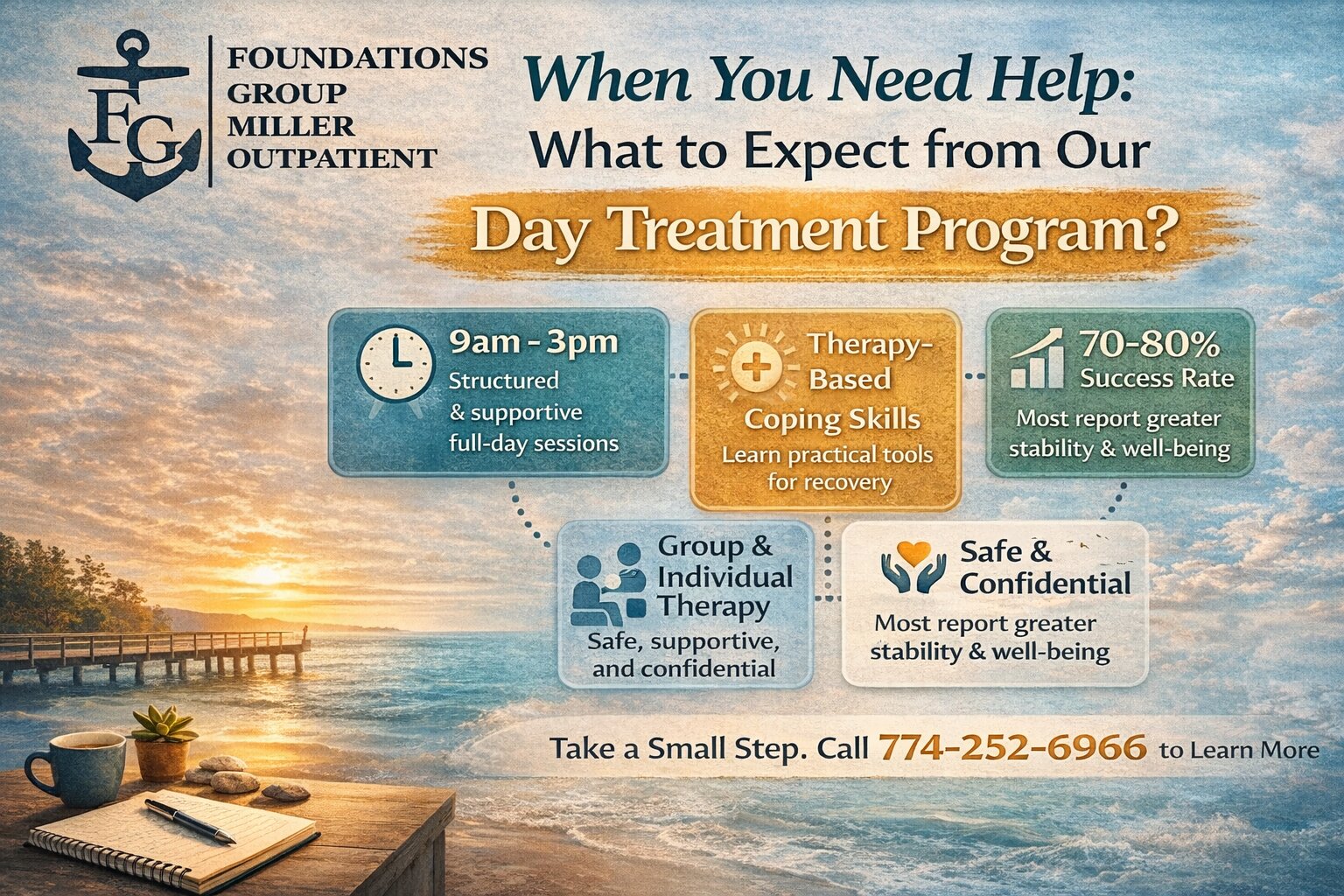
A typical full day includes:
- Morning check-in or process group
- Skill-building sessions
- Individual therapy time
- Psychoeducation or topic-focused groups
- Breaks and meals
- Reflection or wrap-up
It’s organized without being overwhelming. Predictable without being cold.
When someone’s nervous system has been living in fight-or-flight mode — whether from substance use, anxiety, depression, or trauma — predictability is stabilizing. The brain begins to relax when it knows what comes next.
Think of it less like “school” and more like guided rebuilding.
Group Therapy: The Part People Fear — And End Up Valuing
Let’s be honest.
Most people are nervous about group therapy.
They picture spotlights. Forced confessions. Public vulnerability before they’re ready.
That’s not how we do it.
Group sessions are facilitated conversations. They’re structured and professionally led. You’re invited to participate, not pushed. Listening is participation. Sharing a sentence counts.
Over time, something powerful happens.
You hear someone describe a thought you’ve never said out loud — and it sounds exactly like yours.
That moment changes things.
Shame thrives in isolation. It weakens in community.
And while no two stories are identical, the emotional themes — fear, regret, exhaustion, wanting relief — are often shared.
You’re not the only one who feels this way. You never were.
Individual Therapy: Where Your Story Gets Untangled
Group helps you feel less alone. Individual sessions help you go deeper.
This is where your history, patterns, and pain are explored in a safe, confidential space.
Maybe you’re unpacking trauma.
Maybe you’re exploring why you keep returning to the same coping mechanisms.
Maybe you’re grieving — something or someone.
There’s no one-size-fits-all script.
We don’t rush people into emotional territory they’re not ready for. Progress isn’t measured by how intense a session is. It’s measured by insight, safety, and gradual change.
Healing is less about dramatic breakthroughs and more about steady clarity.
Emotional Waves During Treatment
Some days will feel encouraging.
Other days won’t.
You might leave feeling lighter. You might leave feeling emotionally wrung out. Both are normal.
When you start removing unhealthy coping tools — substances, avoidance, numbing — feelings come back online. That can be disorienting at first.
You might think, “If this is recovery, why does it feel harder?”
Because you’re actually feeling things now.
That doesn’t mean it’s failing. It means your system is recalibrating.
Imagine cleaning out a long-ignored room. It looks messier before it looks better.
We expect emotional waves. We plan for them. You won’t navigate them alone.
What Changes (Often Quietly)
Change in a structured daytime program isn’t usually cinematic.
It’s subtle.
You:
- Pause before reacting.
- Use a coping skill instead of spiraling.
- Sleep slightly better.
- Speak up in group.
- Drive home without replaying shame all evening.
These are small wins — but they compound.
People often tell us the biggest surprise wasn’t dramatic transformation. It was stability. The ability to move through a week without everything falling apart.
That’s not small. That’s foundational.
What About Work, Family, or Real Life?
One reason many people choose this level of care is because it allows them to receive strong support while still living at home.
You don’t step away from your entire life.
You return home in the evenings. You apply what you’re learning in real time. You practice communication, boundaries, and coping skills outside the building.
Recovery doesn’t happen in isolation from life — it happens in the middle of it.
That integration matters.
The Fear That It Won’t Work
Almost everyone carries this thought:
What if I do all of this… and I still struggle?
That fear makes sense. Disappointment hurts.
But treatment isn’t about guaranteeing perfection. It’s about building capacity. Tools. Awareness. Support networks.
It’s about shifting from surviving to participating in your life again.
Progress isn’t linear. There will be adjustments. There will be learning curves. But you don’t have to get it right forever. You just have to keep engaging.
And we stay engaged with you.
FAQ: The Questions Most People Don’t Want to Ask Out Loud
How long does this level of care last?
Length varies based on individual needs. Some people attend for several weeks; others need longer support. Treatment plans are personalized and adjusted based on progress and stability.
Will I have to talk about everything right away?
No. You control the pace of your sharing. Trust builds gradually. There’s no expectation to disclose trauma or personal details before you’re ready.
What if I’m nervous about group therapy?
That’s common. Most people are. You’re allowed to observe at first. Participation increases naturally as comfort grows.
Can I still live at home?
Yes. This level of care is designed for people who need structured, full-day support while continuing to live in their home environment.
What happens if I have a hard day?
Hard days are expected. Clinicians are available to help you process difficult emotions. Struggling doesn’t mean you’re failing — it means you’re engaging honestly.
Is this only for addiction?
No. Many individuals attend due to mental health challenges like depression, anxiety, trauma-related symptoms, or when mental health and substance use overlap.
How do I know if this is the right level of care?
You don’t have to decide alone. A clinical assessment helps determine whether a full-day structured approach fits your current needs.
If You’re Standing at the Edge
You don’t have to feel brave.
You don’t have to feel ready forever.
You don’t even have to feel confident this will work.
You just have to feel tired of doing it alone.
A day treatment program offers structure, support, and daily connection without removing you from your life entirely. It’s a space to stabilize, reset, and rebuild — steadily, not dramatically.
If you’re wondering whether this could help, that curiosity matters.
Call 774-252-6966 or visit our Day treatment program services in to learn more about our Day treatment program services in Cape Cod, MA.